New Zealand
1. Higher Education System
Last updated in March 2026
Tertiary education in New Zealand:
In New Zealand, higher or vocational education is referred to as tertiary education, which encompasses all post-secondary school education. The tertiary education system includes a range of public and private independent, self-governing tertiary education organisations (TEOs), each operating under the Education and Training Act 2020 (the Act). Each type of TEO makes a distinctive contribution to the tertiary education system, as outlined in the Act. The Act recognises the strengths and differences of each type of TEO across the whole system.
Types of tertiary education organisations (TEOs):
- Universities
New Zealand has eight autonomous, state-funded universities. Universities offer research-led academic education and degrees from bachelors through to doctoral level.
All of the universities are well recognised internationally. They work with universities in other countries on research and teaching programmes, and with the business community in New Zealand and overseas on research and development.
- Polytechnics
Polytechnics deliver technical, vocational and applied education and training from certificates to doctoral degrees.
- Private training establishments
Private training establishments (PTEs) are privately-owned and offer specific vocational through to doctoral degrees(for example, travel and tourism).
- Wānanga
Wānanga are Māori-centred organisations that foster Mātauranga Māori (Māori knowledge), te reo Māori (Māori language) and tikanga Māori (Māori customs). New Zealand has three legislated wānanga: Te Wānanga o Aotearoa, Te Wānanga o Raukawa, and Te Whare Wānanga o Awanuiārangi. Wānanga are institutions of higher learning that iwi (Māori community or tribal groups) have been instrumental in establishing. They offer certificates, diplomas and degrees. Some teach in specialised areas up to doctorate level.
- Industry Skills Boards
There are eight Industry Skills Boards (ISBs). ISBs are tertiary education organisations that develop qualifications and micro-credentials, and set standards for vocational education across their allocated sectors. They also represent the voice of industry and provide advice on workforce needs. For the transitional period only (2026–2027), they will offer and manage work-based learning, such as apprenticeships.
- Government training establishments
Several government‑run organisations in New Zealand provide education and training programmes. These organisations, known as Government Training Establishments (GTEs), include Oranga Tamariki (Ministry for Children), the NZ Police Training Service Centre, the Department of Corrections, the New Zealand Defence Force, and Fire and Emergency New Zealand.
NOTE: At the senior secondary school level, students may begin to specialise in vocational learning. They can receive support to transition into work or tertiary education through a range of programmes and institutions (e.g. Youth Guarantee and Trade Academies).
Further information: Tertiary education – Ministry of Education
1.1. Schematic Diagram of the Higher Education System
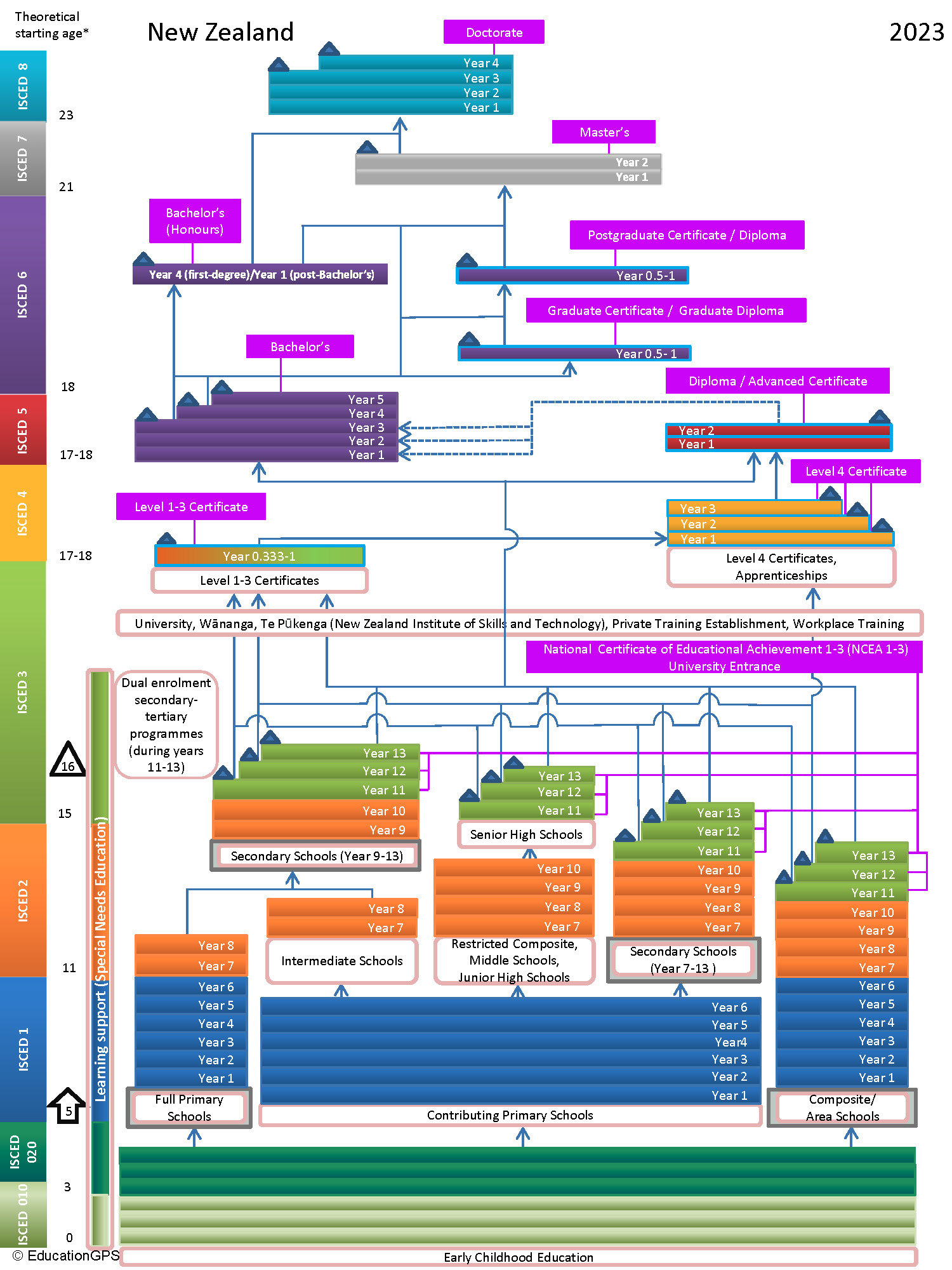
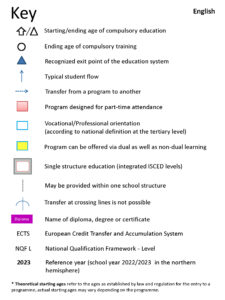
OECD infographic: Education GPS – New Zealand – Overview of the education system (EAG 2025)
1.2. Description of Higher Education System
All organisations operate in an environment of decentralised governance and management. Tertiary education organisations include both public and private institutions. New Zealand’s public education organisations operate under one national system. They include eight universities, sixteen state owned polytechnics, three wānangas and eleven industry training organisations. New Zealand also has five government agencies, such as the New Zealand Police and the New Zealand Army, recognised as government training establishments.
In April 2020, the New Zealand Institute of Skills and Technology (NZIST) was created to provide, arrange, and support a range of vocational education and training, including in the workplace. This involved bringing together all 16 polytechnics (known polytechnics) and nine industry training organisations into a single, national, unified network of regionally accessible vocational education and training.
In 2025, the government decided to disestablish NZIST and transition to multiple regional ITPs from 2026, as outlined in the earlier section.
Stages of Higher Education:
Non-university level : Certificates and Diplomas (Levels 1-6)
Tertiary technical and vocational education and training is provided by polytechnics, wānangas, private training establishments, and industry training organisations. Many tertiary technical and vocational qualifications have integrated work experience, otherwise known as internships, cooperative learning or on-the-job training. Although polytechnics and private training establishments can award professional and applied degrees, the most common qualifications the tertiary technical and vocational education and training providers award are certificates and diplomas. Some universities offer qualifications at those levels, such as English as a Second Language and foundation courses. All approved course and quality assured qualifications outside the universities are listed on the New Zealand Qualifications and Credentials Framework.
University level first stage : Bachelor’s degree / Graduate certificate / Graduate diploma (Level 7)
The first stage of university education leads to the award of Bachelor’s Degrees, Graduate Certificates or Graduate Diplomas. All three are available in all universities, some polytechnics, wānangas, and private training establishments. A Bachelor’s Degree is normally of three years’ duration. Some Bachelor’s Degrees, notably in professional fields such as engineering, health sciences and law, encompass additional academic credits and may require a longer period of study. A Graduate Certificate is designed primarily as a vehicle for degree graduates to pursue further study at an advanced undergraduate level, and a Graduate Diploma allows degree graduates to pursue a significant body of study at an advanced undergraduate level. Entry to Graduate Certificate and Graduate Diploma programmes is open to degree graduates. However, subject to the regulations of the award, those who have been able to demonstrate equivalent practical, professional or educational experience of an appropriate kind may be granted admission.
University level second stage: Postgraduate certificate / Postgraduate diploma / Bachelor honours degree (Level 8)
The second stage of university education is available in universities, polytechnics and leads to the award of Postgraduate Certificates, Postgraduate Diplomas or Bachelor Honours Degrees. A Postgraduate Certificate normally requires six months full-time study following completion of a Bachelor’s Degree, a Graduate Certificate or a Graduate Diploma in a cognate subject. A Postgraduate Diploma normally requires one year full-time study following completion of a relevant Bachelor’s Degree, a Graduate Certificate or a Graduate Diploma. A Bachelor Honours Degree may be either a four-year degree with study at an advanced level that requires a particular level of achievement, or a discrete one-year degree following a Bachelor’s Degree.
University level third stage: Master’s degree (Level 9)
The third stage of university education leads to the award of a Master’s Degree. Master’s Degrees typically consist of 120, 180, or 240 or more credits. Entry to a Master’s Degree is a Bachelor’s Degree or equivalent. For a Master’s Degree of less than 240 credits, additional entry requirements are: For a 120-credit Master’s Degree, a Bachelor Honours Degree, a Postgraduate Diploma or an undergraduate degree followed by relevant professional experience; for a 180-credit Master’s Degree, a Bachelor’s Degree completed at a specified level of attainment.
University level fourth stage: Doctoral degree (including Higher Doctorate) (Level 10)
The Doctoral Degree is a research degree leading to a substantial and original contribution to knowledge. It is normally the culmination of study that begins at the Bachelor’s Degree level and reaches a stage beyond the Master’s Degree, whereby the individual becomes an increasingly independent scholar. The major component of all doctorates is original research which can include a substantial contribution to an established, multidisciplinary, collaborative research activity. A Doctoral Degree requires at least 360 credits at Level 10.
Higher Doctorates are awarded for work of special excellence, as judged by experts of international standing, which is completed before a person makes an application to enrol for the degree. Candidates will normally be expected to have completed at least ten years of independent work and to have published extensively. Publication will normally be in scholarly books and/or in reputable international journals. Individuals in the visual or performing arts will have made equally outstanding contributions in their creative work.
Descriptions of qualifications:
Diploma
Diplomas may be registered at levels 5, 6 or 7 on the New Zealand Qualifications and Credentials Framework. A diploma at level 5 must contain 72 credits at level 5 and have at least 120 of all credits contributing to the qualification at level 4 or above. A diploma at level 6 must contain 72 credits at level 6 and have at least 120 of all credits contributing to the qualification at level 5 or above. A diploma at level 7 must contain 72 credits at level 7 and have at least 120 of all credits contributing to the qualification at level 5 or above. Diplomas are awarded in various fields of study. Diplomas qualify individuals with theoretical and/or technical knowledge and skills in specialised/strategic contexts, and give access to higher studies, or to further professional training. Type of institution where credential is offered: University; Polytechnic; Wānanga (Māori centres of tertiary learning); Private Training Establishment.
Graduate Certificate
Graduate Certificates are registered at level 7 on the New Zealand Qualifications and Credentials Framework. A Graduate Certificate requires a minimum of 60 credits, with a minimum of 40 at level 7 or above. The Graduate Certificate is typically designed as a bridging qualification to postgraduate study for individuals developing educational, professional or vocational knowledge in a new discipline, profession or subject area and/or as a broadening or deepening of skills or knowledge already gained in an undergraduate qualification. Entry is open to degree graduates. However, subject to the regulations of the award, those who have been able to demonstrate equivalent practical, professional or educational experience of an appropriate kind may be granted admission. A Graduate Certificate may provide the basis for postgraduate study. Type of institution where credential is offered: University; Polytechnic; Wānanga; Private Training Establishment.
Graduate Diploma
Graduate Diplomas are registered at level 7 on the New Zealand Qualifications and Credentials Framework. A Graduate Diploma requires a minimum of 120 credits, of which 72 credits must be at level 7 or above. The Graduate Diploma is typically designed as a bridging qualification to postgraduate study as well as broadening knowledge and skills in a familiar subject or discipline, or developing knowledge in a new area. Entry is open to degree graduates. However, subject to the regulations of the award, those who have been able to demonstrate equivalent practical, professional or educational experience of an appropriate kind may be granted admission. A Graduate Diploma may provide the basis for postgraduate study. Type of institution where credential is offered: University; Polytechnic; Wānanga; Private Training Establishment.
Bachelor’s Degree
Bachelor’s Degrees are registered at level 7 on the New Zealand Qualifications and Credentials Framework. A Bachelor’s Degree provides individuals with a systematic and coherent introduction to a body of knowledge of a recognised major subject (or subjects, in the case of a double degree or a double major) as well as to problem-solving and associated basic techniques of self-directed work and learning. A Bachelor’s Degree requires a minimum of 360 credits from levels 5 to 7, with a minimum of 72 credits being at level 7 or higher. Some Bachelor’s Degrees, notably in professional fields such as engineering, health sciences and law, encompass additional credits and may require a longer period of study. For example, an eight semester (four year) degree would normally be equivalent to 480 credits. Bachelor’s Degrees are awarded in all fields of study. The programme for a Bachelor’s Degree consists of a prescribed number of units, papers or courses, which are taken progressively from year to year and involve increasing levels of difficulty. Final exams are held for many courses; others are assessed on the basis of in term work alone. A person who holds a Bachelor’s Degree might be eligible to enrol in a Postgraduate qualification.
Type of institution where credential is offered: University; Polytechnic; Wānanga; Private Training Establishment.
Postgraduate Certificate
Postgraduate Certificates are registered at level 8 on the New Zealand Qualifications and Credentials Framework. The Postgraduate Certificate is designed to extend and deepen an individual’s knowledge and skills. The Postgraduate Certificate involves credits from a specified subject and cognate areas. It recognises continuing professional development or academic achievement in advance of a Bachelor’s Degree in the same area as the individual’s original degree or Graduate Certificate or Diploma. The Postgraduate Certificate requires a minimum of 60 credits at level 8. A Postgraduate Certificate provides the basis for further postgraduate study. Type of institution where credential is offered: University; Polytechnic; Wānanga; Private Training Establishment.
Postgraduate Diploma
Postgraduate Diplomas are registered at level 8 on the New Zealand Qualifications and Credentials Framework. The Postgraduate Diploma is designed to extend and deepen a candidate’s knowledge and skills by building on attainment in the principal subject(s) of the qualifying degree, graduate diploma or graduate certificate. A Postgraduate Diploma prepares an individual for independent research and scholarship in the principal subject of the diploma. It provides a candidate with a systematic and coherent survey of current thinking and research in a particular body of knowledge and may include instruction in the relevant research methodologies. The Postgraduate Diploma requires a minimum of 120 credits from levels 7 and above, with a minimum of 72 credits from level 8. A person who holds a Postgraduate Diploma may be eligible to enrol in a Master’s Degree. Type of institution where credential is offered: University; Polytechnic; Wānanga; Private Training Establishment.
Bachelor Honours Degree
Bachelor Honours Degrees are registered at level 8 on the New Zealand Qualifications and Credentials Framework. A Bachelor Honours Degree recognises distinguished study at level 8. It may be either a 480-credit degree, or a discrete 120-credit degree following a Bachelor Degree. The degree has a minimum of 120 credits at level 8, with a research component that represents at least 30 credits at that level. Research in the context of a Bachelor Honours Degree develops an individual’s ability to design and undertake a project under supervision, and to report on this in an appropriate way. Entry to Bachelor Honours Degrees is normally based on achievement of above average performance in the credits within the Bachelor Degree that are relevant to the proposed honours study. A Bachelor Honours Degree should prepare graduates for admission to further postgraduate study. Type of institution where credential is offered: University; Polytechnic; Wānanga; Private Training Establishment.
Master’s Degree
Master’s Degrees are registered at level 9 on the New Zealand Qualifications and Credentials Framework. A Master’s Degree qualifies individuals who apply an advanced body of knowledge in a range of contexts for research, a pathway for further learning, professional practice and/or scholarship. The Master’s Degree must include a minimum of 40 credits at level 9 with the remainder at level 8. It comprises at least 240 credits in total, except where it builds on 4 years of prior study at Bachelor’s Degree level or above, in which case it can be fewer than 240, but no fewer than 120 credits. Master’s Degrees are structured in three principal ways: By thesis or primarily by thesis: Entry to a Master’s degree by thesis is normally based on a Bachelor Honours Degree or a Postgraduate Diploma in the same field of study. The degree includes 120 credits of which at least 90 credits (at level 9) consists of a research project presented in the form of a thesis, dissertation, substantial research paper or scholarly creative work. By coursework and thesis: Entry to a Master’s Degree by coursework and thesis is normally based on an undergraduate degree in the same field of study. The degree includes 240 credits of which at least 90 credits (at level 9) are in the form of a thesis, dissertation, substantial research paper or scholarly creative work and of which up to 150 credits are from coursework. By coursework: Entry to a Master’s Degree by coursework worth 120 to 240 credits is normally based on an undergraduate degree. The degree is achieved through coursework consisting of courses, project work and research in varying combinations. It may build on undergraduate study in the same academic field, or it may build on the more generic graduate attributes of an undergraduate degree in other fields, or in some cases on relevant professional experience. Master’s Degrees that build on generic attributes and/or experience (often called “conversion Master’s”) are usually in professional fields and are recognised as appropriate professional preparation by the profession or industry concerned. A person who holds a Master’s Degree achieved to an appropriate standard and including a research component of at least 90 credits may be considered for admission to a programme of advanced study and/or original research leading to a Doctoral Degree. Type of institution where credential is offered: University; Polytechnic; Wānanga; Private Training Establishment.
Doctoral Degree
Doctoral Degrees are registered at Level 10 on the New Zealand Qualifications and Credentials Framework. The Doctoral Degree is a research degree leading to a substantial and original contribution to knowledge. It is normally the culmination of study that begins at the Bachelor’s Degree level and reaches a stage beyond the Master’s Degree, whereby the individual becomes an increasingly independent scholar. The major component of all doctorates is original research which can include a substantial contribution to an established, multidisciplinary, collaborative research activity. A Doctoral Degree requires at least 360 credits at Level 10. Type of institution where credential is offered: University; Polytechnic; Wānanga; Private Training Establishment.
World Higher Education Database (WHED) Portal – New Zealand
Understanding the New Zealand Education System | Study With New Zealand – Includes Student Journey map
About the New Zealand Qualifications and Credentials Framework (NZQCF)
1.4. Number of Students in Higher Education
500,000 – learners in tertiary institutions
Ministry of Education 2025 Annual Report – see ” Table 3: Comparison of 2023 and 2024 domestic and international student enrolments and EFTS by subsector”
02 – Tertiary participation | Education Counts
1.5. Structure of Academic Year
A full‑time study load for a student is defined as 120 credits per year, which is equivalent to 60 ECTS (European Credit Transfer and Accumulation System) credits.
Each qualification has minimum credit requirements, and credit values reflect the total amount of learning involved. One credit represents 10 notional hours of learning and assessment.
Notional hours refer to the typical amount of time a learner spends studying, including self‑directed learning, homework, and assignments.
Academic year structure vary by provider type, is flexible and not centrally mandated. Universities generally operate on two semesters (February-June and July-November), with optional summer school (December-January). Other TEOs may use trimester or rolling enrolment systems (ie, students can start at various times throughout the year rather than a single annual start date).
Assessment methods vary according to your course and institution. Assignments and/or tests and/or practical work during the semester almost always contribute to the end-of-semester grade. Some courses are entirely assessed by semester coursework, but most combine coursework and a final exam.
The Tertiary Education Commission’s Delivery Classification Guide helps providers to accurately assign a delivery classification and funding category to each course within a programme or micro-credential they deliver.
Semester Dates 2025 updated.pdf
2026 Delivery Classification Guide
1.6. National Qualifications Framework (or Similar)
The New Zealand Qualifications and Credentials Framework (NZQCF) is at the centre of New Zealand’s education and training system.
All secondary and tertiary qualifications and credentials approved by the New Zealand Qualifications Authority (NZQA) or Universities New Zealand are listed on the NZQCF, and come with an assurance of quality that is recognised and trusted worldwide.
The NZQCF includes information about qualifications and credentials, including qualification types and levels.
It helps individuals and organisations understand the level of skill and knowledge someone with a qualification or credential has. It makes it easier for countries and regions to compare qualifications.
The framework is also important for recognising and helping to advance Mātauranga Māori.
Relationship between the NZQCF and other tertiary education settings | Te hononga i waenga i te NZQCF me ētahi atu whare mātauranga tuatoru
The NZQCF is foundational to an integrated tertiary education system. While the Framework lists approved qualifications and credentials, quality assurance of education organisations confirms that stakeholders can have confidence in the qualifications and credentials held by individuals. Subject to government policy and settings, tertiary funding subsidies are only available for qualifications and micro-credentials that are quality assured and listed on the NZQCF. Student loans and allowances, and student and graduate visas for international students, are only granted on the basis of study towards and achievement of qualifications listed on the NZQCF
About the NZQCF – NZQA – NZQA – See page 8 for infographic.
1.7. Learning Outcomes in Higher Education
Yes, please see page 16,17 and 18 in the New Zealand Qualifications and Credentials Framework.
Each qualification on the NZQCF is defined by a level descriptor expressed as learning outcomes.
The descriptors broadly define what a graduate is expected to know and be able to do, and the context in which a graduate can operate, as a result of the learning associated with the qualification or credential awarded. This may include mātauranga Māori and te ao Māori perspectives.
The level descriptors include three domains – knowledge, skills and context. The sub-domains of knowledge, practice and performance, critical thinking, communication, collaboration, environment, and autonomy and responsibility are embedded within the level descriptors to ensure consistency of what graduates are expected to know, what graduates are expected to be able to do, and where and how graduates can apply their learning.
The New Zealand Qualifications and Credentials Framework
1.8. Admission Requirements to Higher Education
National Certificate of Educational Achievement
The National Certificate of Educational Achievement (NCEA) is New Zealand’s national qualification for senior secondary school students. NCEA is part of the New Zealand Qualifications and Credentials Framework (NZQCF). NCEA provides the pathway to tertiary education and workplace training.
There are three NCEA qualifications, one at each of Levels 1-3 of the qualification system. Each NCEA qualification requires 80 credits. The Level 1 NCEA requires 80 credits at level 1 or above, with at least 8 credits in literacy standards and 8 credits in numeracy standards. Completion of NCEA Level 2 requires 80 credits, of which 60 need to be at level 2 or above. The other 20 can be from any level of the NQF. Completion of NCEA Level 3 requires 80 credits, of which 60 need to be at level 3 or above. The other 20 credits need to be at level 2 or above of the NQF.
[NOTE that New Zealand is in the process of replacing the NCEA with new national qualifications which will be introduced in 2028 to 2030].
Undergraduate admission requirements:
For domestic students:
University Entrance (UE) is the minimum requirement to go from school to a New Zealand university. Being awarded University Entrance also opens doors to tertiary study in other countries.
To be awarded UE, you need:
- NCEA Level 3
- 14 credits at Level 3 in each of 3 approved subjects
- 10 Literacy credits at Level 2 or above, made up of:
- 5 credits in reading
- 5 credits in writing.
- 10 Numeracy credits at Level 1 or above, made up of:
- co-requisite Level 1 Numeracy unit standard 32406 or Te Pāngarau unit standard 32412, or
- certain achievement standards.
For international students:
- Overseas qualification equivalent to the New Zealand University Entrance
- English language proficiency: In general, a minimum score of 6.0 IELTS/ TOEFL (iBT) minimum score 79-80. (see below for further information about English language proficiency requirements)
Postgraduate admission requirements:
Bachelor Honours Degree
- A 480-credit (or more) degree is open to those who have met the specified entrance requirements, normally at level 3 on the NZQCF.
- Entry to a 120-credit discrete degree is normally based on achievement of above average performance in the credits within the Bachelor’s Degree that are relevant to the proposed honours study.
Graduate Certificate and Graduate Diploma
- Entry is open to degree graduates. However, subject to the regulations of the award, those who have been able to demonstrate equivalent practical, professional or educational experience of an appropriate kind may be granted admission.
Postgraduate Certificate and Postgraduate Diploma
- A Bachelor’s Degree or Graduate Certificate or Graduate Diploma in a related subject, or relevant skills and knowledge acquired through appropriate work or professional experience.
Master’s Degree
- A minimum entry qualification of a Bachelor’s Degree or equivalent.
- Providers of programmes leading to a Master’s Degree are responsible for establishing entry requirements.
- Admission as an individual to a Master’s Degree is based on the evaluation of documentary evidence (including the academic record) of the individual applicant’s ability to undertake postgraduate study in a specialist field of enquiry or professional practice.
- Exceptionally, applicants not meeting the minimum entry qualification requirement but with extensive, substantial and appropriate documented professional experience may be considered.
Doctoral Degree
- A Bachelor Honours or Master’s Degree achieved to a specified level (which includes having undertaken research), an approved international equivalent, or other approved evidence of adequate training and ability.
English language entry requirements for international students:
English language entry requirements for international students are set through the Programme Approval, Recognition and Accreditation Rules. The Rules sets out the approved tests and required outcome that may be used as evidence of English language proficiency for international students. The outcomes listed are the minimum scores or grades for each test or qualification that qualify a student for enrolment at each programme level.
The New Zealand Qualifications and Credentials Framework
https://www2.nzqa.govt.nz/ncea/understanding-secondary-quals/university-entrance/
https://www.universitiesnz.ac.nz/international-students/am-i-eligible
https://www2.nzqa.govt.nz/tertiary/english-language-entry-requirements-for-international-students/
1.9. Grading System
New Zealand’s higher education grading generally uses a letter system (A+ to E) reflecting percentage bands, with A+ (90-100%) being top and C- (50-54%) the minimum pass, though percentage cutoffs can vary between institutions.
A GPA is calculated by assigning points to grades, weighing each grade by the point value of the course, adding up all the weighted values, and then dividing the sum by the total number of points.
Each education institution has its own grading system policy, or assessment and examinations regulations. Some vocational training courses may use competency-based grading such as Achieved and Not Achieved. The cut-off points/percentages for these results vary depending on qualifications or institutions.
Credit requirements
See 1.5 above.
About New Zealand qualifications and credentials – NZQA
Guidelines for listing, approval and maintaining degrees and related qualifications
The New Zealand Qualifications and Credentials Framework
1.10. Tuition Fee System for International Students
Tuition fees for international students vary depending on the type of course, where the student studies and how long for. The fees listed below are in New Zealand Dollars (NZD).
Diplomas/Certificates
Choose a course to suit your budget. For example, study for a one-term New Zealand Certificate in Engineering for $23,376 or a one-year Diploma in Computing for $46,752.
Bachelor’s degree
Fees range from about $35,000 to $55,000* per year, with higher fees for subjects such as medicine and veterinary science. Many bachelor’s degrees can be completed in three years. Important to note: Fees can vary, so it’s best to contact education providers for exact course costs. *Cost updated March 2025.
Postgraduate degree
Fees range from about $20,000 to $45,000, with higher fees for subjects such as medicine and veterinary science.
PhDs
International PhD students pay the same as New Zealand PhD students, which is about $6,500 to $7,500* per year for most subjects. Fees do vary depending on the education provider so it’s to best to contact them for exact costs per course. Important to note: Fees can vary, so it’s best to contact education providers for exact course costs. *Cost updated March 2025.
Tuition fees and cost of living | Study with New Zealand
1.11. Graduation Requirements and/or Qualification Awarding Requirements
Bachelor Degree:
- a minimum of 360 credits at levels 5 to 7, with a minimum of 72 credits at level 7 or above.
Bachelor Honours Degree:
- a minimum of 120 credits at level 8 or above, including a research component of at least 30 credits
Graduate Certificate:
- a minimum of 60 credits, including at least 40 credits at level 7 or above.
Graduate Diploma:
- a minimum of 120 credits, including at least 72 credits at level 7 or above.
Postgraduate Certificate:
- a minimum of 60 credits at level 8 or above.
Postgraduate Diploma:
- a minimum of 120 credits at levels 7 or above, with a minimum of 72 credits at level 8 or above.
Master’s Degree:
- a minimum of 120 credits at levels 8 and above, with at least 40 credits at level 9. Master’s Degrees typically consist of 120, 180, or 240 or more credits.
Doctoral Degree:
- at least 360 credits at level 10
the body of work that leads to the award of a doctorate will be one or more of the following: (a) a thesis, which may include published work; (b) creative work with an exegesis; or (c) coursework in combination with a thesis, which may include published work, or creative work with an exegesis.
The New Zealand Qualifications and Credentials Framework (see page 14)
https://www2.nzqa.govt.nz/qualifications-and-standards/about-qualifications-and-credentials/
1.12. Relevant Current and Prospective Reforms in Higher Education
See the Tertiary Education Strategy 2025–2030 which sets out the long-term strategic direction and current and medium-term priorities for tertiary education.
2. Quality Assurance in Higher Education
2.1. Quality Assurance Body in Higher Education
The quality assurance bodies in higher education in New Zealand are the New Zealand Qualifications Authority (NZQA) and the Universities New Zealand (UNZ).
NZQA
NZQA is one of the government agencies that manage and regulate education in New Zealand and are responsible for making sure that tertiary education in New Zealand is high quality.
NZQA’s quality assurance system applies to all tertiary education institutions except universities: private training establishments, wānanga, polytechnics and government training establishments.
Universities New Zealand
Universities New Zealand (UNZ) is responsible for quality assurance in universities. It approves degrees and qualifications offered by universities through the Committee on University Academic Programmes (CUAP).Until 2024, Academic Quality Agency for New Zealand Universities (AQA), established as an independent body by the New Zealand Vice-Chancellors’ Committee in 1993, conducted external academic audits and checked that degrees and qualifications offered are good quality and well-taught. AQA wound up its operations in 2024, and the Transitional Academic Audit Committee (TAAC) was formed by UNZ as a temporary body to ensure continuity in quality assurance while a new audit system is being created.
2.2. Quality Assurance System
| Study programme | Institution | Further explanation | |
| Voluntary | |||
| Compulsory | √ | √ | |
| Regularity (years) | Up to 5 years | Annually | From 2026 |
| External | √ | √ | |
| Internal | √ | √ |
NZQA’s integrated Quality Assurance Framework (iQAF) was implemented from 2026. It replaced the Evaluative Quality Assurance Framework (EQAF) which was in place from 2009 to 2025.
Description of iQAF (from 2026):
The iQAF is designed to provide confidence that learners are achieving robust, credible and relevant qualifications and credentials that prepare them to meet iwi/hapū/whānau, employer, and community needs in New Zealand and internationally.
The iQAF is intended to reflect NZQA’s regulatory principles of being impact-led, anticipatory, and adaptable.
- Impact-led– being data led, focusing on system performance, building provider capability through Educate and Inform and sharing insights and information, emphasising TEO’s role in quality and quality improvement through TEO Review
- Anticipatory and adaptable – risk-informed approach to all activities (particularly monitoring) and to help us prioritise and focus our resources in high-impact areas; system risk scan to share intelligence and work with the sector to prevent issues from occurring or reducing any adverse effect
- Adaptable – streamlining approval processes and how/what we monitor to reflect different provider contexts and needs
Those are underpinned by our cornerstones with quality assurance activities informed by data, ranging from, for example, provider registration, programme and qualification approvals, and ongoing monitoring of providers and programmes.
Description of EQAF (framework; 2009-2025):
- Four main parts to the system: entry processes, maintaining quality, external evaluation and review, and managing risk.
- Based on self-assessment by providers, which is used to monitor their own quality and the outcomes for learners and stakeholders, and to make worthwhile improvements to outcomes and learner achievement.
- The EQAF was introduced in 2009. While it applies a rigorous approach to the then New Zealand Qualifications Framework and quality assurance, the tertiary education sector has undergone considerable change. This has led to new quality assurance activities being progressively introduced to the EQAF.
- Teaching, learning, and assessment have also continued to evolve. For example, advances in technology have changed assessment practices. How we quality assure teaching, learning and assessment also needs to adapt and change.
- There were opportunities to streamline what NZQA requires from tertiary providers, and to look across the tertiary education system to generate insights to foster system improvements.
NZQA role as Code administrator
The Tertiary and International Learners Code of Practice protects international learners and domestic tertiary students in Aotearoa.
As the Code administrator, NZQA:
- monitor compliance with the Code
- support providers to meet their Code obligations
- promote the Code
investigate learner complaints and look into possible Code breaches.
Our quality assurance system – NZQA
Integrated Quality Assurance Framework
2.3. Programme Authorisation and Quality Assurance
Non-university institution
Programmes leading to a qualification listed on the New Zealand Qualifications and Credentials Framework (NZQCF) must be approved by NZQA.
Approved programmes can only be delivered by accredited providers. NZQA grant accreditation when they consider a provider capable of delivering an approved programme.
The minimum information required from all providers is:
- evidence of academic quality assurance approval e.g. Minutes of Academic Board approval from wānanga and Te Pūkenga or for smaller PTEs detailed records of programme approval by appropriately designated people in the organisation’s quality management system
- full programme details with supporting documents
- agreement to participate in the external consistency processes specified as part of the qualification.
Universities
The Committee on University Academic Programmes (CUAP) considers academic matters across the university system, including the exercise of programme approval and moderation procedures, advice and comment on academic developments and encouraging universities to develop courses of study that will facilitate the transfer of students between programmes and institutions.
Under New Zealand legislation, the New Zealand Vice-Chancellors’ Committee (operating as Universities New Zealand – Te Pōkai Tara) exercises the powers of programme approval and accreditation held by the New Zealand Qualifications Authority (NZQA) for the rest of the tertiary education sector. Universities New Zealand has delegated its powers to CUAP. CUAP undertakes its programme approval and accreditation functions within policies such as the gazetted criteria for programme approval developed by NZQA after consulting the university sector. Representatives of CUAP meet representatives of NZQA four times a year to discuss matters of mutual interest and when asked to do so CUAP nominates university representatives to working groups convened by NZQA to consider a range of academic matters.
CUAP decisions on academic programmes
CUAP meets twice a year (usually July and October) to consider proposals made by the universities for new qualifications or major changes to existing ones.
CUAP also holds one further meeting annually to deal with a range of academic matters.
Programme approval and provider accreditation – NZQA
Programme approval and accreditation criteria – NZQA
Programme Approval, Recognition, and Accreditation Rules 2025 – NZQA
Universities:
Programme approval and accreditation / CUAP | Universities New Zealand – Te Pōkai Tara
Lists of the qualifications approved, deleted and renamed since 1990 are available.
New qualifications approved by CUAP may be found on the New Zealand Qualifications Framework – a comprehensive list of all quality-assured qualifications in New Zealand.
3. Credit System in Higher Education
3.1. Description of Credit System
Credit requirements
Each qualification has minimum credit requirements. Credit values reflect the amount of learning in the qualification. One credit represents 10 notional hours of learning and assessment.
Notional hours are the amount of time a learner typically spends studying, including self-directed learning, homework and assignments.
A learner studying full-time can usually earn 120 credits in a year.
About New Zealand qualifications and credentials – NZQA
The New Zealand Qualifications and Credentials Framework (page 16,17 and 18 for credits needed for each level of study)
3.2. Credit Transfer System(s)
New Zealand uses the European Credit Transfer and Accumulation System (ECTS).
A total of 120 credits is considered an annual full-time study load for a student. 120 credits is equivalent to 60 ECTS.
Description of the New Zealand Tertiary Education System 2010
NZQA Recognition of learning for credit
3.3. Additional Information
3.4. Is Application of Credit System in Higher Education Institutions Mandatory?
Yes
All qualifications and credentials on the NZQCF are based on a credit system. The credit system provides a uniform measure of student workload, with a standard full-time study load considered to be 120 credits. Each credit generally represents approximately 10 hours of learning (including both contact and self-directed hours).
The New Zealand Qualifications and Credentials Framework
3.5. Number of Credits per Academic Year/Semester
A full-time learner can usually complete 120 credits of learning in a year of study, typically requiring 1,200 hours of learning.
The New Zealand Qualifications and Credentials Framework
3.6. Number of Credits per Higher Education Cycle
See 1.2 and 1.11 above.
3.7. Description of Credit Unit
One credit represents 10 notional learning hours.
The New Zealand Qualifications and Credentials Framework
3.8. Link between Learning Outcomes and Credits
The New Zealand Qualifications and Credentials Framework (Please see page 14, 16, 17 and 18)