
Indonesia
Last updated in October 2026
Chapter 1: Higher Education System
1.1. Schematic Diagram of the Higher Education System
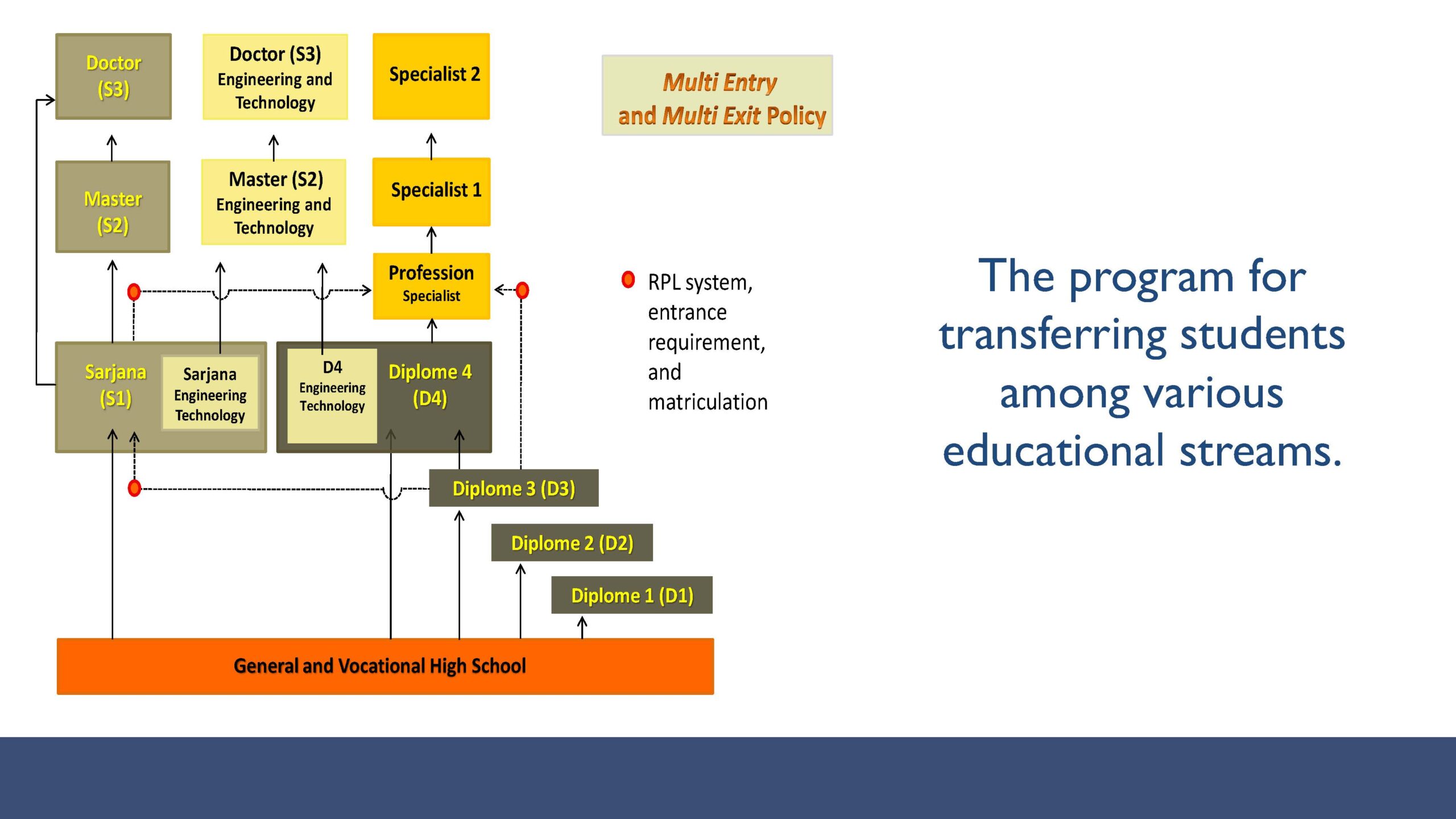
1.2. Description of Higher Education System
Higher Education in Indonesia is regulated in the Republic of Indonesian Law Number 12 of 2012 concerning Higher Education that provides the legal foundation for the organization, governance, and development of higher education in Indonesia. It defines higher education as an organized, systematic effort to develop learners’ potential through the teaching and learning process, research, and community service—known as the Tri Dharma Perguruan Tinggi (Three Pillars of Higher Education) as follow:
Functions and Objectives
According to the Law, higher education serves to Develop intellectual capacity, character, and civilization of the nation, produce graduates who are faithful, knowledgeable, capable, creative, independent, and responsible citizens; Advance science, technology, and culture through education, research, and community service; and Promote innovation that contributes to national competitiveness and societal welfare.
Types and Forms of Higher Education Institutions
The Law recognizes several forms of higher education institutions, including:
- Universities (multidisciplinary),
- Institutes (specialized in one technical education with various sub),
- College (specialized in one field),
- Polytechnics,
- Academies, and
- Community Academies.
These institutions may be organized by the government (public institutions) or society through legal entities (private institutions).
Academic and Vocational Pathways
Higher education in Indonesia consists of:
- Academic Education that directed toward mastery and development of science and technology (e.g., Bachelor’s, Master’s, Doctoral programs).
- Vocational Education that directed toward applied skills for employment and industry needs (e.g., Diploma programs).
- Professional Education that directed toward preparing graduates for regulated professions (e.g., medicine, law, teacher training).
Autonomy of Higher Education Institutions
The Law grants academic autonomy to institutions to determine programs, curricula, and learning processes, while also ensuring compliance with national standards of higher education. Certain institutions may obtain legal entity status (Perguruan Tinggi Negeri Badan Hukum / PTNBH), allowing them greater autonomy in management and financing.
1.3. List of Higher Education Institutions
Indonesia has a total of 4,416 higher education institutions across the country. Of this number, 2,937 institutions fall under the Ministry of Higher Education, Science, and Technology (MoHEST), comprising 125 public universities and 2,812 private institutions. Meanwhile, 1,309 institutions are administered by the Ministry of Religious Affairs (MoRA), consisting of 87 public and 1,222 private institutions. In addition, there are 170 institutions managed by other ministries, organizations, or institutions.
All data and figures on higher education institutions in Indonesia are regularly updated and publicly available through the Higher Education Data Centre (PDDIKTI) at https://pddikti.kemdiktisaintek.go.id/ (currently available in Bahasa Indonesia).
1.4. Number of Students in Higher Education
Indonesia currently has approximately 9.967.477 students enrolled in its higher education system, distributed across all Higher Education Institution that fall under MoHEST, MoRA, and other institutions.nFor details of distribution and updated number, also available at https://pddikti.kemdiktisaintek.go.id/, specifically at Statistik > Mahasiswa.
1.5. Structure of Academic Year
The start and end of the academic year and semesters/terms are set by each university (Further information: Law of the Republic of Indonesia Number 12 of 2012 concerning Higher Education).
1.6. National Qualifications Framework (or Similar)
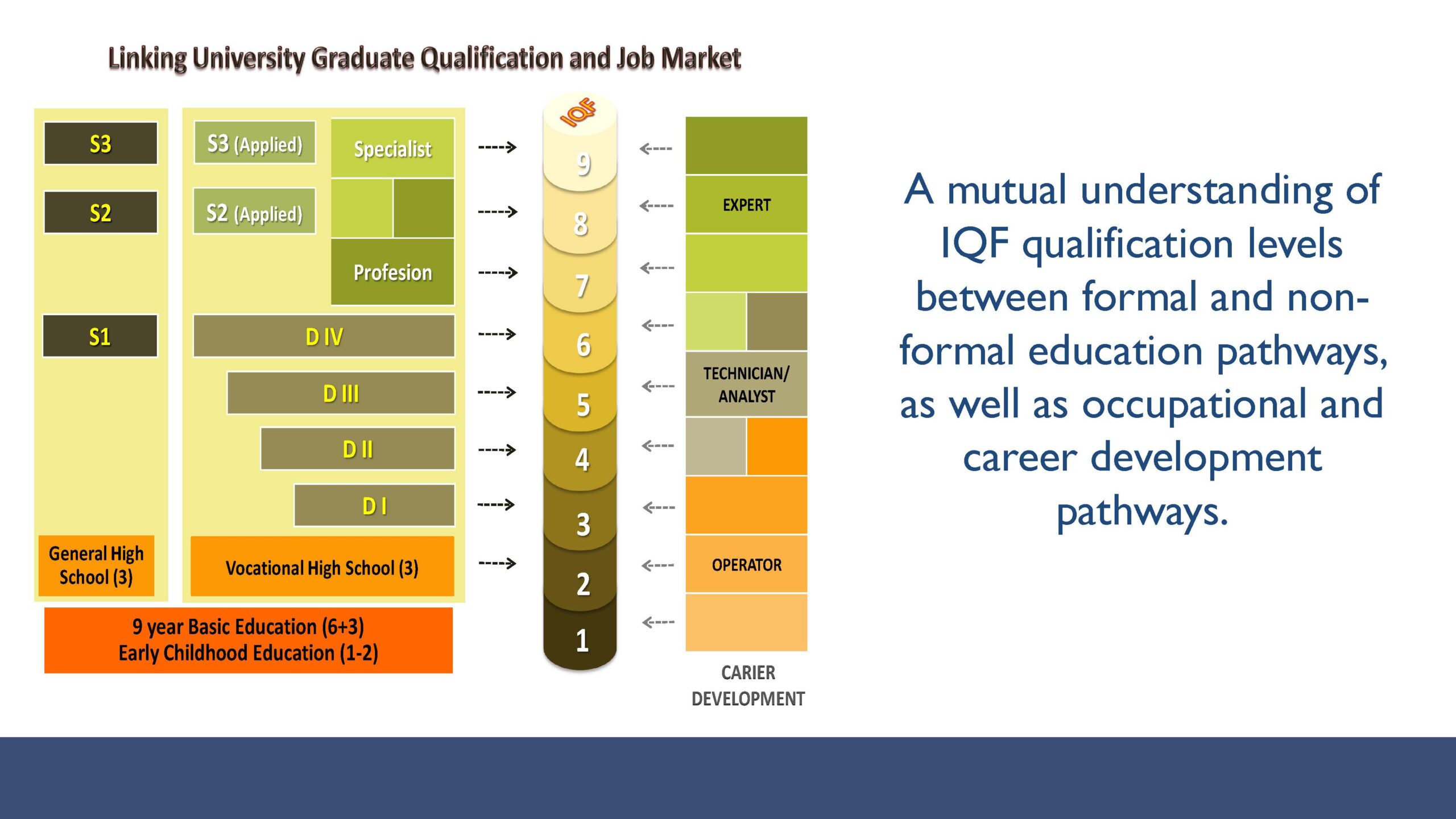
Indonesia has a competency qualification grading framework that can match, equalize, and integrate the fields of education and work training as well as work experience in order to provide recognition of work competencies in accordance with the job structure in various sectors, namely the Indonesian National Qualifications Framework (Kerangka Kualifikasi Nasional Indonesia/KKNI).
KKNI consists of nine levels of qualification, starting from level one as the lowest level to level nine as the highest level.
- Graduates of basic education equivalent to level 1;
- Graduates of secondary education at least equivalent to level 2;
- Diploma 1 (D1) graduates are at least equivalent to level 3;
- Diploma 2 (D2) graduates are at least equivalent to level 4;
- Diploma 3 (D3) graduates are at least equivalent to level 5;
- Diploma 4 (D4) or applied bachelor graduates and bachelor graduates at least equivalent to level 6;
- Applied masters and masters graduates are at least equivalent to level 8;
- Applied doctoral graduates and doctoral graduates equivalent to level 9;
- Graduates of professional education equivalent to level 7 or 8;
- Graduates of specialist education equivalent to level 8 or 9.
The legal basis for more details: Presidential Regulation of the Republic of Indonesia No. 8 of 2012 concerning the Indonesian National Qualifications Framework. To understand the national qualification frameworks, we provide the schematic visual as follows:
1.7. Learning Outcomes in Higher Education
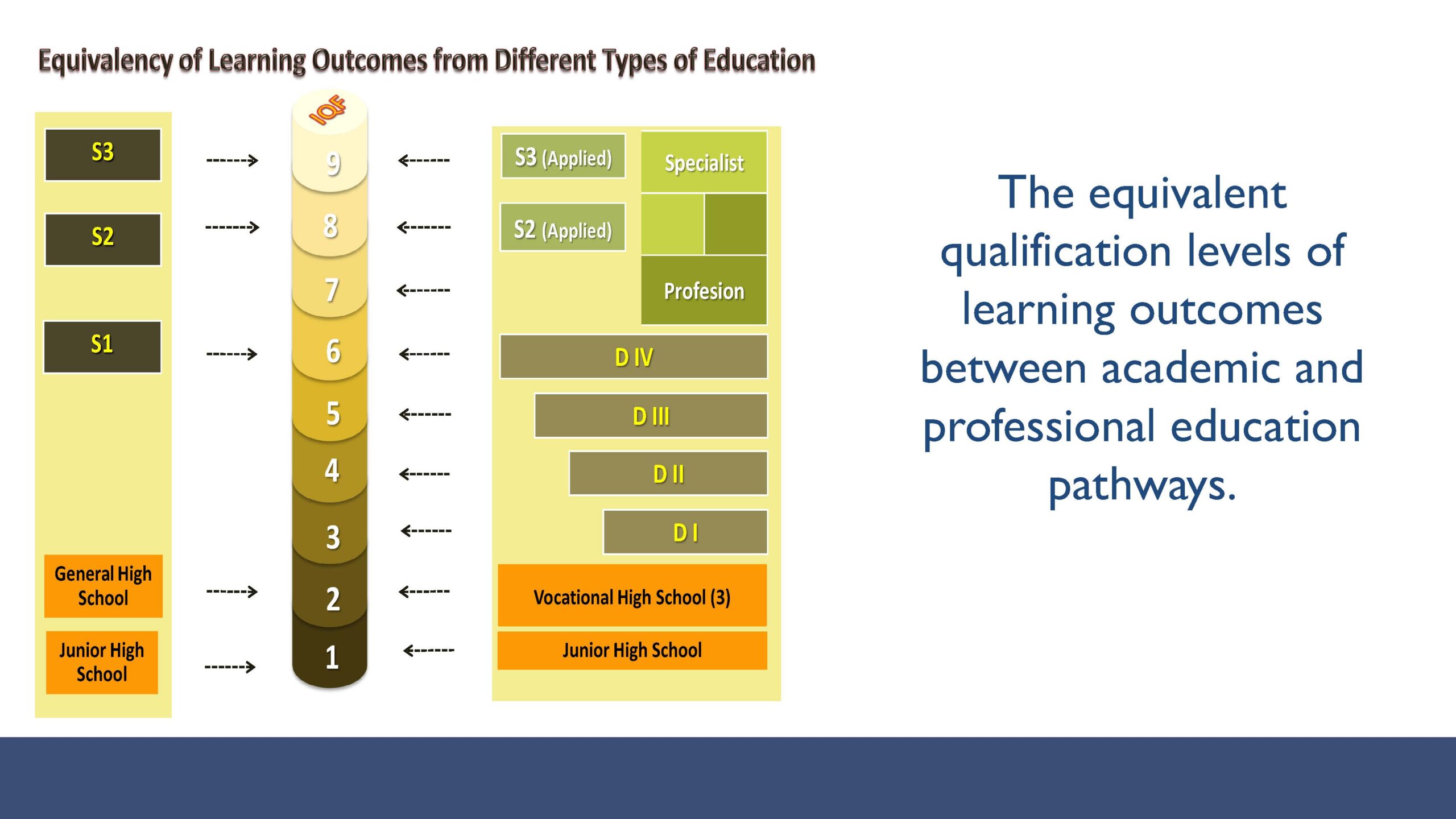
The Indonesian National Qualifications Framework (KKNI) is directly linked to working with learning outcomes at the programme level. Every study programme must refer to the KKNI level descriptors; design and assess learning outcomes accordingly; and ensure alignment with national standards, accreditation requirements, and labour market needs. This ensures standardized quality across institutions and relevance to the world of work.
All higher education curricula in Indonesia are required to be based on learning outcomes as guided by KKNI, National Higher Education Standards (Standar Nasional Pendidikan Tinggi/ SN-Dikti), and national education law. This ensures alignment between education, industry, and international standards.
1.8. Admission Requirements to Higher Education
The regulation about admission requirements is also regulated through Law No. 12 of 2012 concerning Higher Education, specifically article number 73-74, as generated that Admission to higher education is open to graduates of secondary education (or equivalent) who meet academic requirements as determined by each higher education institution. This includes graduates from SMA (Senior High School), SMK (Vocational High School), or other equivalent educational institutions, both domestic and foreign.
The law recognizes multiple pathways, such as National selection (e.g., SNBP/SNBT for public universities), Institutional selection, and other mechanisms set by the higher education institution in accordance with the law. Students with special achievements (academic or non-academic), students from underprivileged backgrounds, or those from remote and disadvantaged regions may be given affirmative policies to support access to higher education. Foreign students may be admitted according to applicable laws and regulations, often requiring specific administrative and academic criteria.
1.9. Grading System
All regulations for the higher education grading system are written in detail in the Regulation of the Minister of Higher Education, Science, and Technology Number 39 of 2025 concerning the assurance of the quality of higher education.
1.10. Tuition Fee System for International Students
In principle, Indonesia applies the same tuition fee system for both domestic and international students. The difference lies in the amount of tuition fees (Uang Kuliah Tunggal/UKT), which may vary depending on the program and student category.
The overall mechanism is regulated under the Regulation of the Minister of Education, Culture, Research, and Technology Number 2 of 2024 concerning the Standard Unit Cost of Higher Education Operations at State Universities. This regulation sets the mandatory fee for Grade 1 and Grade 2 categories, while allowing higher education institutions to determine additional tuition fee categories based on their study programs.
For international students or special programs (e.g., international classes, collaborative programs), institutions are permitted to set tuition fees that may differ from regular categories, in line with the provisions of the regulation.
1.11. Graduation Requirements and/or Qualification Awarding Requirements
Regulations on higher education requirements in Indonesia are primarily regulated in Law Number 12 of 2012 concerning Higher Education and Regulation of the Minister of Education, Culture, Research, and Technology (Permendikbudristek) Number 6 of 2022 and Permendikbudristek Number 50 of 2024 concerning Diplomas, Competency Certificates, and Professional Certificates, which stipulate that students must meet requirements that meet higher education standards and must have a Diploma, Competency Certificate, or Professional Certificate that is legally issued.
1.12. Relevant Current/Prospective Reforms in Higher Education
The Government Strengthens Higher Education Through Digital Transformation: Implementation of Electronic Signatures and National Diploma Numbering.
Chapter 2: Quality Assurance in Higher Education
2.1. Quality Assurance Body in Higher Education
Indonesia has several external quality assurance bodies in higher education to ensure that universities and study programs meet national and international standards. The main national body is the National Accreditation Board for Higher Education (BAN-PT), which is responsible for both institutional and program accreditation across all academic disciplines. BAN-PT evaluates higher education institutions based on criteria such as governance, curriculum, research, community service, facilities, and continuous quality improvement.
In addition to BAN-PT, Indonesia also has Independent Accreditation Agencies (Lembaga Akreditasi Mandiri/LAM) that provide accreditation for specific disciplines or professional fields. Each LAM focuses on a particular area (for example, health sciences, engineering, or business) and applies standards that are tailored to the needs and characteristics of that discipline. These agencies operate under the coordination of MoHEST, and they complement BAN-PT by offering more specialized and field-based quality assessments.
Together, BAN-PT and the various LAMs play a key role in maintaining and enhancing the quality of higher education in Indonesia, ensuring that graduates are competitive both nationally and globally.
References:
- National Accreditation Board for Higher Education (BAN-PT): https://www.banpt.or.id.
- Ministry of Education, Culture, Research and Technology – Higher Education Quality Assurance: https://dikti.kemdikbud.go.id.
2.2. Quality Assurance System
Indonesia implements a national quality assurance system for higher education called the Higher Education Quality Assurance System (Sistem Penjaminan Mutu Pendidikan Tinggi/ SPM Dikti). Quality Assurance System is specific ruled through Ministerial Regulation of Education, Culture, Research and Technology/Science and Technology No. 39 of 2025 which ensure that every university and study programme achieves and continuously improves quality in accordance with the SN Dikti.
The regulation defines components of quality assurance as follow:
Internal Quality Assurance (Sistem Penjaminan Mutu Internal/SPMI)
Each higher education institution must operate an Internal Quality Assurance System as the core of quality management.
- Purpose: SPMI ensures that planning, implementation, evaluation, control, and improvement of education, research, and community service meet or exceed SN-Dikti.
- Cycle: SPMI follows a continuous cycle consisting of (1) setting standards, (2) implementing standards, (3) evaluating implementation, (4) controlling and correcting deficiencies, and (5) improving standards and processes.
- Autonomy: Institutions have the authority to design their own internal standards and mechanisms as long as they remain aligned with SN-Dikti.
- Reporting: Outcomes of SPMI must be documented and reported through the national higher education database (Pangkalan Data Pendidikan Tinggi/PD-Dikti) to enable monitoring by the government and public stakeholders.
External Quality Assurance (Sistem Penjaminan Mutu Eksternal/SPME)
To validate the effectiveness of SPMI and provide public accountability, External Quality Assurance is conducted through accreditation.
- Implementing agencies:
- BAN-PT carries out institutional and programme accreditation where no independent agency exists.
- LAM perform accreditation for specific disciplines or professional fields, based on recognition from the Ministry.
- Compulsory nature: Accreditation is mandatory for all institutions and study programmes.
- Regularity: Accreditation status is reviewed on a five-year cycle. Institutions or programmes with excellent performance may receive an extended validity period, while those that fail to meet standards must undergo follow-up evaluation.
- Process: SPME involves submission of a self-evaluation report derived from SPMI data, document assessment, external peer review, and, if required, site visits. The final decision determines the accreditation rating (e.g. Excellent, Very Good, Good).
Higher Education Database (PDDIKTI) to collect and monitor data
It is a national integrated information system managed by Ministry that responsible for Higher Education in Indonesia. PDDIKTI serves as the official repository of data on higher education institutions, study programs, lecturers, students, academic activities, and graduates across Indonesia. All univeristies given the access to insert data. In the platform, Students, employers, and the public can verify student status, study program accreditation, and diplomas.
Key Information Stored in PDDIKTI:
- Statistical landscape of Higher Education in Indonesia
- Institutional profiles (public & private universities)
- Study programs and curricula
- Student biodata and academic records
- Lecturer data and research activities
- Graduation and diploma records
| Study programme | Institution | Further explanation | |
| Voluntary
Please tick. |
– | – | Accreditation is not voluntary; it is required by national regulation |
| Compulsory
Please tick. |
✔ | ✔ | Accreditation by BAN-PT or relevant LAM is mandatory for all programs and institutions. |
| Regularity (years)
Please indicate the number of years |
5 years (new BAN-PT/LAM accreditation cycle) | 5 years | Under the new system, accreditation status is reviewed every 5 years; high-performing programs/institutions may receive extended status (up to 7 years). |
| External
Please tick. |
✔ | ✔ | Conducted by BAN-PT and LAM with periodic site visits, document review, and peer assessment. |
| Internal
Please tick. |
✔ | ✔ | Each institution must operate an Internal Quality Assurance System (SPMI) that continuously monitors and improves quality. |
| Further information:
To summarise, Law 12/2012 mandates a national quality assurance system consisting of: · Internal Quality Assurance (by each institution), · External Quality Assurance (accreditation by BAN-PT or LAM), and · Higher Education Database (PDDIKTI) to collect and monitor data. This framework ensures accountability, continuous improvement, and alignment with national education goals. |
|||
2.3. Programme Authorisation and Quality Assurance
In Indonesia, programme authorization (official permit to offer a study programme) is granted by MoHEST once the programme is registered in PDDIKTI and SN-DIKTI.
This authorization is directly linked to the Higher Education Quality Assurance System (SPM Dikti) under Ministerial Regulation No. 39 of 2025:
- Each university operates an Internal Quality Assurance System (SPMI) to plan, implement and monitor quality standards.
- An External Quality Assurance (SPME) process, conducted through accreditation by BAN-PT or relevant Independent Accreditation Agencies (LAM), provides the official evaluation of programme quality. The accreditation result serves as a key legal basis for the ministry to grant, renew, or revoke programme authorization. Programmes that fail to achieve or maintain accreditation cannot admit new students.
A complete list of accredited or officially recognized programmes is available at:
- PDDIKTI: https://pddikti.kemdiktisaintek.go.id
- National Accreditation Board (BAN-PT): https://www.banpt.or.id
Chapter 3: Credit System in Higher Education
3.1. Description of Credit System
Indonesia uses a national credit system known as Sistem Kredit Semester (Semester Credit System/SKS). This system is designed to measure the academic workload of students, acknowledge their learning progress, and provide flexibility in curriculum design. The legal basis for the SKS is primarily the Regulation of the Minister of Higher Education, Science, and Technology No. 39 of 2025 concerning Quality Assurance of Higher Education. 1 SKS is defined as 45 hours learning activity in a semester and considered equivalent to 1.5 to 1.67 ECTS (European Credit Transfer and Accumulation System).
3.2. Credit Transfer System(s)
- AUN – ACTS: The AUN ASEAN Credit Transfer System
- UMAP – UCTS: The University Mobility in Asia and the Pacific Credit Transfer Scheme
- Other, please specify: ECTS is not a nationally adopted system but is widely used as a reference for credit mapping and transfer in bilateral agreements with European universities.
Furthermore, the national “Kampus Berdampak Program” or Right to Learn Outside the Study Program, or previously known as Merdeka Belajar Kampus Merdeka (MBKM) policy heavily facilitates credit transfer. This policy allows the fulfilment of a student’s learning load to be conducted outside of their primary study program in several forms:
- In a different study program at the same university.
- In the same or a different study program at another university.
- At an institution outside of higher education.
Learning activities at institutions outside of higher education can be determined by the Ministry and/or the university leader. These activities must be carried out with the guidance of a lecturer or another supervisor determined by the university and/or the partner institution.
3.3. Additional Information
3.4. Is Application of Credit System in Higher Education Institutions Mandatory?
The application of the SKS is mandatory for all higher education institutions in Indonesia as stipulated by the National Standards for Higher Education (SN-DIKTI), as regulated by the Regulation of the Minister of Higher Education, Science, and Technology No. 39 of 2025 concerning Quality Assurance of Higher Education.
3.5. Number of Credits per Academic Year/Semester
A standard academic year consists of two semesters. A typical full-time student workload is 18-24 credits (SKS) per semester. The maximum number of credits a student can take is generally 24, and this is often contingent on achieving a high Grade Point Average (GPA) in the preceding semester. Therefore, the standard number of credits per academic year is approximately 36-48 SKS.
3.6. Number of Credits per Higher Education Cycle
The total number of credits required for graduation varies by the level of study, which aligns with the KKNI levels mentioned in Chapter 1: Diploma 1: minimum 36 SKS; Diploma 2: minimum 72 SKS; Diploma 3 (KKNI Level 5): minimum 108 SKS; Applied Bachelor / Bachelor (KKNI Level 6): minimum 144 SKS; Master / Applied Master (KKNI Level 8): minimum 36 SKS ; Doctoral / Applied Doctoral (KKNI Level 9): regulated by each Higher Education Institution.
3.7. Description of Credit Unit
One credit (1 SKS) is defined by the total student workload per week over one semester (approximately 16 weeks of academic activities). The total workload for 1 SKS is 45 hours per semester, which may be broken down into: scheduled face-to-face learning (e.g., lectures, tutorials), structured academic activities (e.g., assignments, projects), and independent learning (e.g., reading, self-study). For practical work, labs, or studio work, 1 SKS is equivalent to 170 minutes of hands-on activity per week, or 45 hours per semester.
3.8. Link between Learning Outcomes and Credits
Learning outcomes and credits are directly related. As established in Chapter 1, all curricula must be based on learning outcomes aligned with the KKNI. The number of credits (SKS) assigned to a course quantifies the estimated student effort and workload required to achieve the specific learning outcomes defined for that course. The total credits for a degree program are structured to ensure that a graduate has successfully achieved all the specified Programme-Level Learning Outcomes (Capaian Pembelajaran Lulusan/CPL).