
Finland
Chapter 1: Higher Education System
1.1. Schematic Diagram of the Higher Education System
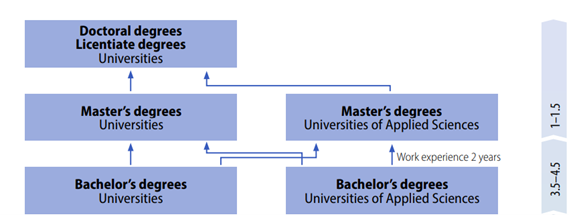
1.2. Description of Higher Education System
Finland has a dual higher education system made up of universities and universities of applied sciences (UAS). Both institution types operate with a high level of autonomy: they make their own decisions about administration, teaching, research and degree programmes. Although they form one national system, their missions differ clearly from each other.
Universities focus on scientific research and research‑based education. They offer bachelor’s, master’s and doctoral degrees and prepare students for academic careers and expert positions that require strong theoretical knowledge. In contrast, universities of applied sciences provide professionally oriented education closely connected to working life. They offer bachelor’s and master’s degrees that emphasise practical skills, applied research and regional development.
Below is a more detailed overview of the degree structure and the typical duration and credit requirements of each study cycle.
Universities
- Focus on scientific research and research‑based education
- Degrees offered: Bachelor, Master, Doctoral
- First cycle/Bachelor: 180 ECTS, ~3 years
- Second cycle/Master: 120+ ECTS, ~2 years
- Long single-cycle programmes:
- Medicine & Veterinary Medicine 360 ECTS (6 years)
- Dentistry 330 ECTS (~5.5 years)
- Only universities can award doctoral degrees (coursework + dissertation)
Universities of Applied Sciences (UAS)
- Focus on professionally oriented education and working‑life skills
- Strong link to industry, regions and applied RDI work
- First cycle /UAS Bachelor: 210–270 ECTS, ~3.5–4.5 years
- Second cycle/UAS Master: 60 or 90 ECTS, ~1.5–2 years
- UAS Master’s degrees require relevant work experience
Doctoral Degrees/third cycle
- Offered only by universities
- Includes 20–60 ECTS of postgraduate studies
- Requires independent research, dissertation and public defence
1.3. List of Higher Education Institutions
Ministry of Education and Culture: Higher education institutions, science agencies, research institutes and other public research organisations https://okm.fi/en/heis-and-science-agencies
Universities in Finland: A total of 13 universities operate within the Ministry of Education and Culture’s administrative branch: https://okm.fi/en/universities
Higher education degrees in the military sector are completed at the Finnish National Defence University, which operates under the defence administration: Finnish National Defence University https://maanpuolustuskorkeakoulu.fi/en/frontpage
Universities of applied sciences in Finland: A total of 22 universities of applied sciences operate as public limited companies in the Ministry of Education and Culture’s administrative branch: https://okm.fi/en/universities-of-applied-sciences
Police University College, which operates under the mandate of the Ministry of the Interior: https://polamk.fi/en/front-page
Åland University of Applied Sciences: https://www.ha.ax/en/
1.4. Number of Students in Higher Education
Number of students in Finland
Total number of students in HEIs (2025): 357 591
| Total number of students in universities 176 175 | |
| 1st cycle | 85 956 |
| 2nd cycle | 68 295 |
| 3rd cycle | 21 924 |
| Source: Vipunen, Education Statistics Finland, 2025 | |
| Total number of students in universities of applied sciences: 181 419 | |
| 1st cycle | 156 492 |
| 2nd cycle | 24 927 |
| Source: Vipunen, Education Statistics Finland, 2025 | |
| Total number of foreign students enrolled in full degree programmes: 37 287 | |
| 1st cycle | 19 767 |
| 2nd cycle | 12 015 |
| 3rd cycle | 5 505 |
| Source: Vipunen, Education Statistics Finland, 2025 | |
1.5. Structure of Academic Year
In Finland, the academic year begins on 1 August and ends on 31 July. There is no national regulation on the exact number of teaching days or holidays. Instead, higher education institutions are autonomous and decide their own schedules. This means that semesters and breaks may vary between institutions.
Usually there are two semesters
- Autumn semester: from September to the end of December
- Spring semester: from mid-January to the end of May/early June
A third semester at summertime is also used in some institutions.
There are usually two breaks
- Summer break: from late May to late August / early September
- Winter break: from late December to mid-January
Institutions may offer courses also during breaks, such as intensive courses during summer break.
1.6. National Qualifications Framework
The Finnish National Framework for Qualifications (FiNQF) describes the qualifications, syllabi and other extensive competence modules that belong to the Finnish national education system. The FiNQF includes, among other things, general education, vocational education and higher education.
The qualifications, syllabi and other extensive competence modules are classified into eight levels based on the required competences. The competences acquired at each level are defined in the Government Decree, and the level descriptors are in line with the level requirements of the European qualifications framework (EQF).
level 2: Basic education syllabus, Preparatory education for working life and independent living (TELMA) and Integration training
level 3: Preparatory education for programmes leading to an upper secondary qualification (TUVA) and Non-qualification programmes at folk high schools for learners within the scope of compulsory education
level 4: General upper secondary school syllabus and the Matriculation Examination, Upper secondary vocational qualifications and further vocational qualifications
level 5: Specialist vocational qualifications
level 6: Bachelor’s degrees at universities and Bachelor’s degrees at universities of applied sciences
level 7: Master’s degrees at universities and Master’s degrees at universities of applied sciences
level 8: Universities’ and National Defence University scientific and artistic postgraduate degrees (licentiate and doctor degrees), the General Staff Officer’s Degree, the Specialist Degree in Veterinary Medicine, and Specialist training in medicine and Specialist training in dentistry
Source: Finnish National Agency for Education https://www.oph.fi/en/education-and-qualifications/qualifications-frameworks
1.7. Learning Outcomes in Higher Education
The Finnish National Qualifications Framework (FiNQF), aligned with the European Qualifications Framework (EQF), defines the levels of qualifications and the expected knowledge, skills and competences for each level, including higher education degrees. National legislation requires that higher education institutions design degree programmes and courses based on intended learning outcomes. Each programme and its modules must specify the degree cycle, scope (credits) and the intended learning outcomes. These outcomes guide teaching, assessment and quality assurance processes.
1.8. Admission Requirements to Higher Education
Admission to higher education in Finland is regulated under the Universities Act and the Universities of Applied Sciences Act. These laws establish the general framework for eligibility and entry criteria for degree studies (Bachelor’s, Master’s, Doctoral). Admission decisions and specific criteria are made by each institution.
Eligibility to apply for a Bachelor’s degree programme applicants must have successfully completed their upper secondary education, for example the Finnish matriculation examination or a foreign qualification that provides eligibility for higher education studies in the awarding country.
For a Master’s degree, applicants must have a relevant Bachelor’s degree or equivalent.
The requirement for master’s programmes in universities of applied sciences (UAS) is a bachelor’s level degree and at least two years of work experience.
Foreign applicants coming from outside the EU/EEA area or Switzerland pay an application fee and, for English-taught programmes, must provide proof of English language skills (e.g., IELTS, TOEFL). For Finnish- or Swedish-taught programmes, proof of language proficiency is required. Some fields, such as medicine or art, may have additional requirements like entrance exams or portfolios.
Application fee
Applicants from outside the EU, EEA or Switzerland are required to pay an application fee in order to apply to higher education studies. More information https://opintopolku.fi/konfo/en/sivu/application-fee
Joint application to higher education
Bachelor’s level studies are provided by both universities and universities of applied sciences (UAS). It is possible to apply for most of the bachelor’s level studies conducted in English in joint application to higher education.
It is possible to apply for master’s level degree programmes provided in English in joint application and separate applications.
More information on Joint application to higher education: https://opintopolku.fi/konfo/en/sivu/joint-application-to-higher-education
Studyinfo.fi – national portal for programme descriptions, entry requirements, and application procedures: https://opintopolku.fi/konfo/en/
A video on ow to apply to higher education in Finland Your quick guide on how to apply to university studies in Finland
1.9. Grading System
There is no national grading system in Finland as higher education institutions are autonomous in determining what grading system is to be used. No overall grade is given for a degree and students are not ranked. Students receive grades on the courses they have completed
Many HEIs use grading system where completed studies are assessed on the following scale of 0–5:
- 5 = Excellent
- 4 = Very good
- 3 = Good
- 2 = Satisfactory
- 1 = Passable
- 0 = Fail
1.10. Tuition Fee System for International Students
Students coming from outside the EU/EEA area or Switzerland are required to pay both an application fee when applying to higher education and tuition fees for studies at universities and universities of applied sciences. Tuition fees apply to all programmes taught in English at both the first and second cycle levels.
Higher education institutions must charge fees that cover the full cost of the studies. As each institution sets its own tuition fees, Finland does not define an official national standard.
In practice, the typical annual tuition fee for non‑EU/EEA students ranges from EUR 8,000 to 20,000, depending on the institution and degree programme.
More detailed information on tuition fees and fee levels can be found on the websites of each higher education institution.
1.11. Graduation Requirements and/or Qualification Awarding Requirements
Finland uses the ECTS credit system for all higher education degrees, and students graduate once they have completed the required number of credits, passed all compulsory studies and finished a final thesis or project.
Bachelor’s degrees at universities consist of 180 ECTS credits, including basic and intermediate studies, elective studies and a Bachelor’s thesis. Universities of Applied Sciences (UAS) award Bachelor’s degrees of 210–270 ECTS credits, which include professional studies, elective studies, extensive practical training and a Bachelor’s thesis.
Master’s degrees at universities typically comprise 120 ECTS credits, consisting of advanced studies, electives and a Master’s thesis. UAS Master’s degrees are 60–90 ECTS credits, and admission requires a UAS Bachelor’s degree plus two years of relevant work experience. Most courses are graded on a 0–5 scale, where grades 1–5 are passed.
Students receive their qualification once all required coursework and the thesis have been completed with passing grades and all programme-specific requirements have been fulfilled.
1.12. Relevant Current/Prospective Reforms in Higher Education
According to the Ministry of Education and Culture’s ongoing renewal project for the Vision for Higher Education and Research, Finland’s higher education and research system needs to adapt to growing international competition, changes in the labour market and broader societal expectations. The key themes of the reform include raising the overall level of education, strengthening research and R\&D activity, deepening international cooperation and updating the structure of the higher education system. Long-term funding models and new financing sources are also becoming more important.
The overall aim is to build a high-quality, internationally competitive system that benefits society as a whole. Reaching this goal requires increasing the number of skilled professionals, improving research infrastructures and ensuring that higher education institutions can respond effectively to digitalisation and global uncertainties.
Student wellbeing, equal access to education and opportunities for continuous learning are central to maintaining Finland’s position as a knowledge-driven society. At the same time, higher education institutions are expected to strengthen their cooperation and clarify their division of labour so that limited resources can be used as effectively as possible.
Chapter 2: Quality Assurance in Higher Education
2.1. Quality Assurance Body in Higher Education
Finnish Education Evaluation Centre (FINEEC) is responsible for the evaluation of education provided by universities and universities of applied sciences (UAS) in Finland. The evaluation types in higher education are audits of higher education institutions (HEIs), thematic and system evaluations, and evaluations of study fields. In addition, FINEEC carries out as a fee-based service EUR-ACE accreditations of engineering degree programmes.
https://www.karvi.fi/en/evaluations/higher-education
2.2. Quality Assurance System
Universities and universities of applied sciences themselves have the primary responsibility for the quality of the education they provide. According to the Universities Act and the Universities of Applied Sciences Act, higher education institutions (HEIs) must evaluate their education and research.
In addition, HEIs must regularly participate in external evaluations focusing on their operations and quality systems. These evaluations are mainly carried out by the Finnish Education Evaluation Centre (FINEEC). The results of the evaluations must be published.
External evaluations of quality systems have an advisory orientation. They aim at involving staff, students and stakeholders of the HEI in recognising strengths, good practices and development areas. The goal is to support HEIs in achieving their own objectives and support the continuous development of higher education.
In addition, higher education institutions can participate in external programme accreditations.
2.3. Programme Authorisation and Quality Assurance
There is no mandatory external programme-level authorization for Finnish higher education institutions (HEIs). The educational responsibility agreed upon by the Ministry of Education and Culture and the higher education institutions regulates which degrees the institutions are allowed to offer. Within the scope of this responsibility, HEIs independently develop degree programmes and their content. HEIs are responsible for the quality of their degree programmes. They must evaluate their education and research and regularly participate in external evaluations of their quality systems. In addition, HEIs may participate in external programme accreditations.
All degree programs in HEIs can be found on the Studyinfo portal: https://opintopolku.fi/konfo/en/
3.1. Description of Credit System
The Finnish credit system is compatible with the European Credit Transfer and Accumulation system (ECTS). Courses are assigned credits according to the workload they require. One credit corresponds to an average of 27 hours of student’s work. The average workload required to complete one academic year is 1,600 hours, equivalent to 60 credits.
Credits and the extent of higher education degrees are regulated by the Government Decree on Universities of Applied Sciences https://www.finlex.fi/fi/lainsaadanto/2014/1129#sec_1 and the Government Decree on University Degrees and Specialisation Education https://www.finlex.fi/fi/lainsaadanto/2004/794
3.2. Credit Transfer System(s)
- ECTS – European Credit Transfer and Accumulation System
The Finnish credit system is compatible with the ECTS system.
3.3. Additional Information
3.4. Is Application of Credit System in Higher Education Institutions Mandatory?
Yes
3.5. Number of Credits per Academic Year/Semester
The targeted credit accumulation for full-time studies is 60 credits per academic year.
3.6. Number of Credits per Higher Education Cycle
In the university sector, a bachelor’s degree typically comprises 180 credits and is intended to be completed in three years. After the bachelor’s degree, a master’s degree usually takes about two years, corresponding to 120 credits.
In the universities of applied sciences, the scope of a bachelor’s degree (UAS) is either 210, 240, or 270 credits, depending on the programme, and takes approximately 3.5 to 4.5 years to complete. Studies leading to a master’s degree (UAS) comprise 60, 90, or 120 credits, depending on the programme.
3.7. Description of Credit Unit
Credits are determined by the amount of work they require. 1 credit corresponds to an average of 27 hours of work.
3.8. Link between Learning Outcomes and Credits
Credits measure the amount of work, not learning outcomes. Different levels of higher education degrees, however, are defined based on learning outcomes.